
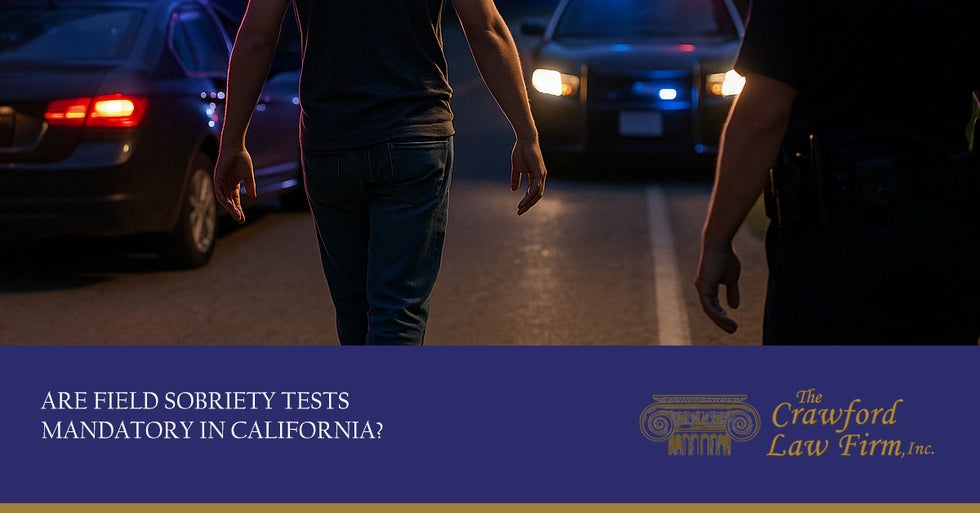
One of the more iconic images in the media related to drunk driving is the field sobriety test. This is a test requiring a driver to close their eyes and touch their nose, balance on one foot, or walk a straight line. Allegedly, a police officer can determine whether someone is under the influence of alcohol based on the results of these tests.
Is this accurate? Can a police officer accurately determine whether someone is too drunk to drive based on these tests? And is it legal to refuse to take a field sobriety test in California?
Field Sobriety Tests Are Optional
A person's performance on field sobriety tests is not definitive proof of whether they are under the influence of alcohol. And, unless you are on probation for a previous DUI conviction*, you are not required to perform field sobriety tests.
People who have not consumed any alcohol may do very badly on these tests. If you are over the age of forty, are overweight, have a bad back, have bad balance, are tired, or are nervous, you may perform poorly on balance and coordination tests. And police officers often administer the tests incorrectly, which invalidates the results.
Unfortunately, the police are not required to tell you any of this. If the police detain you for suspicion of driving under the influence, they can ask you to submit to field sobriety tests without informing you that the tests are optional.
Many people agree to take these tests because they believe that they are required to do anything a police officer tells them. However, you are only required to follow lawful orders from a police officer. Since field sobriety tests are not dictated by law, an officer cannot order you to perform them.
Implied Consent and Chemical Testing
Many people believe that submitting to field sobriety tests is mandatory. When you get a license in California, you are subject to implied consent. That means you must submit to chemical testing (either a blood or breath test) if you are lawfully arrested for a DUI.
If you refuse to submit to chemical testing after an arrest, your license will be suspended, even if you are not driving drunk. However, unless you are on probation for a previous DUI, you are not required to perform the field sobriety tests.
Penalties for Failing Field Sobriety Tests
If you agree to take field sobriety tests, the police officer can use the results of that test to determine whether to arrest you. And evidence of your poor performance can be used against you in court. The police are not required to tell you what counts as a mistake. So, many people who thought they did well on the tests were surprised to learn later that police report says they performed poorly.
Penalty for Refusing a Field Sobriety Test
Unless you are on probation for a previous DUI, you are not legally required to submit to field sobriety tests. However, if you are arrested and charged with DUI, a prosecutor may argue that your refusal to take the tests shows a “consciousness of guilt” (meaning that you knew you would fail the tests because you had too much to drink). But, on balance, it is still not a good idea to take the tests, because very few people are going to perform field sobriety tests flawlessly.
Should You Take a Field Sobriety Test if You Are Sober?
Even if you are stone-cold sober, there is no advantage to taking field sobriety tests. Even an Olympic gymnast can do poorly on field sobriety tests. Frequently, there is no bodycam or dashcam footage of the tests. So, there is no way to effectively dispute a police officer's report of your performance.
Field sobriety tests are notorious for resulting in false positives. Try closing your eyes and touching your nose or walking a straight line with your arms at your side. No imagine performing these tests at night, on the side of the road, with a uniformed police officer with a gun and a badge watching for any tiny mistake you might make. Very few people can perform these tests perfectly. A police officer is free to interpret even minor mistakes as evidence that you are too drunk to drive.
Know Your Rights and Refuse a Field Sobriety Test
If you are stopped for suspicion of a DUI, you have the right to refuse to perform field sobriety tests. There is no benefit from taking tests, and your performance will likely be used against you. However, if you are arrested for a DUI, a post-arrest chemical test is mandatory, and refusing it can result in serious consequences, including loss of your license for a year or longer.
If you are detained by the police for suspicion of DUI, the best course of action is to politely, but firmly, decline to answer any questions or to take any tests. If the police arrest you for suspicion of driving under the influence, you must then submit to a post-arrest blood or breath test or risk losing your license for at least a year.
*Terms of probation for a DUI conviction frequently require the driver to submit to field sobriety tests and blood/breath tests at the request of law enforcement.
Understanding your rights during a DUI stop can make all the difference. If you've been charged with DUI or believe your rights were violated during a field sobriety test, The Crawford Law Firm, Inc. is here to help. Contact our experienced defense team today for a confidential consultation and protect your future.


Comments
There are no comments for this post. Be the first and Add your Comment below.
Leave a Comment